


Metal Injection Molding MIM Process Flow Chart
Mar 20, 2023
Metal Injection Molding MIM Process Flow Chart
Metal Injection Molding (MIM) Process Flow
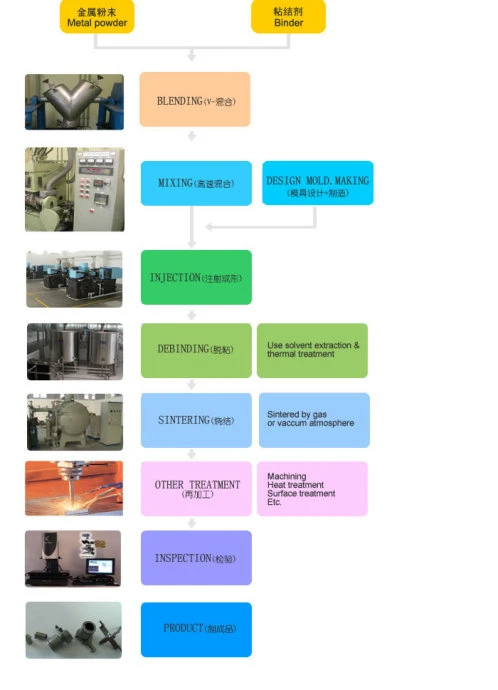
Metal Injection Molding (MIM) Process Flow
Careful netizens have also made animated demonstrations of MIM process flow for metal injection molding, which can help us more intuitively understand the MIM process flow.
Brief introduction to various stages of metal injection molding MIM process
2.1 Metal powder
The particle size of metal powder used in the metal injection molding process is generally between 0.5 and 20 μ m. Theoretically, the finer the particles, the larger the specific surface area, and easier to shape and sinter. While traditional powder metallurgy processes use more than 40 μ M thick powder. There are also many methods for preparing MIM metal powders. Depending on functional requirements.
2.2 Organic adhesive
The role of organic adhesive is to bond metal powder particles, making the mixture rheological and lubricating when heated in the barrel of the injection molding machine, which is a carrier that drives the flow of powder. Therefore, the selection of adhesives is the key to the entire powder injection molding. Requirements for organic adhesives: ① Low dosage, that is, using fewer adhesives can produce better rheological properties of the mixture; ② No reaction, no chemical reaction with metal powder during the removal of adhesive; ③ Easy to remove, without residual carbon in the product.
A typical adhesive accounts for approximately 40% (volume fraction) of the mixture, which corresponds to approximately 6% (mass fraction) of the adhesive for steel, approximately 14% (mass fraction) for alumina, and less than 3% (mass fraction) for tungsten. The formulation of adhesive requires consideration of a balance of several factors. The ideal powder should have a high tamping density. Sufficient adhesive is required to fill the gaps between the powder particles and to lubricate the powder during mold filling.
2.3 Mixing and granulation
During mixing, metal powder and organic adhesive are uniformly mixed together to adjust their rheological properties to suit the injection molding state. The uniformity of the mixture directly affects its fluidity, which affects the injection molding process parameters and even the density and other properties of the final material. The leftovers and waste products generated during the injection molding process can be re crushed, granulated, and recycled.
2.4 Injection molding
The process in this step is consistent with the plastic injection molding process in principle, and the equipment conditions are also basically the same. During the injection molding process, the mixture is heated into a plastic material with rheological properties within the barrel of the injection machine, and injected into the mold under an appropriate injection pressure to form a blank. The density of the injection molded blank should be uniform on the microscopic level, so that the product shrinks uniformly during the sintering process. Controlling molding parameters such as injection temperature, mold temperature, injection pressure, and holding time is crucial to achieving stable green weight. It is necessary to prevent the separation and segregation of components in the injection material, otherwise it will lead to uncontrolled size and distortion and scrap.
2.5 Degreasing
The organic adhesive contained in the formed blank must be removed before sintering, and this process is called debonding. The debonding process must ensure that the adhesive is gradually discharged from different parts of the blank along the micro channels between the particles, without reducing the strength of the blank. After solvent extraction of a portion of the adhesive, thermal debonding is performed to remove the remaining adhesive. During debonding, it is necessary to control the carbon content and reduce the oxygen content in the blank.
2.6 Sintering
Sintering is carried out in a sintering furnace with a controlled atmosphere. The high density of MIM parts is achieved through high sintering temperature and long sintering time, thereby greatly improving and improving the mechanical properties of the part material.
2.7 Post processing
Necessary post processing is required for workpieces with relatively precise dimensional requirements. Because the accuracy of MIM sintered parts is generally within ± 0.3%. If the accuracy requirements are high, machining processes such as CNC, turning, and grinding are required.
2.8 Others
At the same time, in order to meet certain performance requirements, some MIM sandblasting and MIM polishing processes will also be carried out. Due to different requirements, the surface of the product will undergo treatment processes such as MIM electroplating and MIM-PVD.


